Ultra-Hardliners Threaten Iran’s Leadership: Enforce Hijab or Face Consequences!
In recent developments, Iran’s ultra-hardliners and their associated vigilantes are expressing increasing concern that the Islamic Republic risks alienating its most loyal supporters by suspending strict hijab enforcement. As the nation grapples with societal changes and protests, the implications of these shifts are becoming more pronounced.
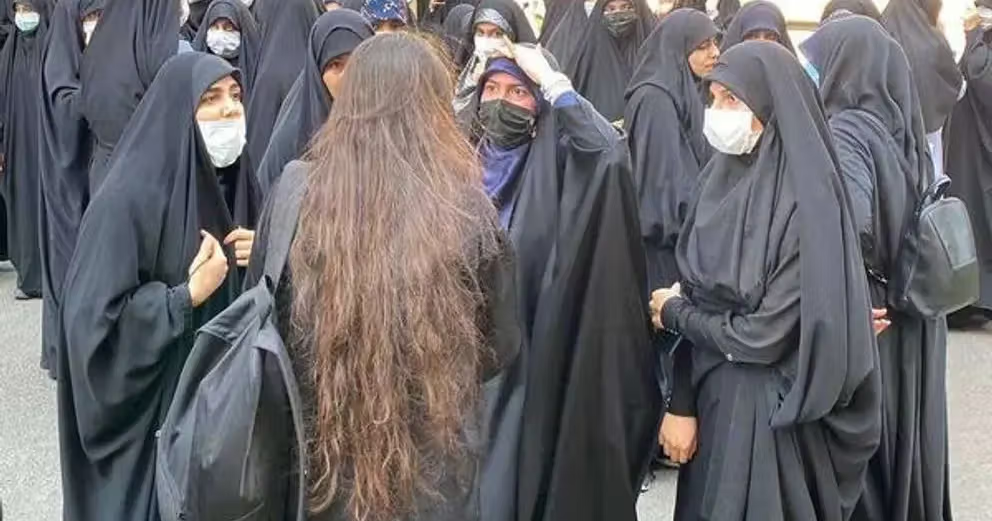
Last week, a viral video showcased ultra-hardliner lawmaker Mohammad-Mannan Raisi fiercely criticizing the Supreme National Security Council (SNSC) for its decision in mid-September to halt the implementation of the controversial Hijab and Chastity Law. This law faced global condemnation, with the United Nations denouncing it as “gender apartheid.” According to the UN, “The new hijab law marks an intensification of state control over women’s bodies in Iran and is a further assault on women’s rights and freedoms.”
Raisi highlighted that the hardcore supporters of the clerical regime have endured significant economic hardships out of loyalty to the Islamic Republic, expecting the government to uphold Sharia law. He warned that by showing indifference towards religious beliefs and values, authorities are acting like a secular government, which could erode the trust of their devoted base. He stated, “The hard core of the system will be disillusioned if you suspend God’s commandments and fail to implement them based on unjustified expediency.”
This warning suggests that loyalists might lose their motivation to support those in power, whom they believe are responsible for enforcing Sharia law. The SNSC’s decision to not enforce the controversial law likely received the endorsement of Supreme Leader Ali Khamenei, who has refrained from discussing the issue in recent speeches, despite previously declaring in April 2023 that disregarding hijab is “religiously and politically haram (forbidden).”
Authorities seem to be proceeding cautiously; enforcing the controversial law, which includes severe penalties for violators, could incite renewed anti-government protests. The defiance of hijab rules has surged among Iranian women since the violent protests following the death of Mahsa Amini, a 22-year-old woman who died while in the custody of the morality police for not adhering to hijab regulations. This incident sparked widespread opposition to Iran’s long-standing hijab law.
Today, many women are openly rejecting the mandatory hijab, long tunics, and trousers outlined by Sharia law. They are often seen engaging in public displays of defiance, including singing and dancing. The initial protests, which resulted in over 500 deaths at the hands of security forces, led to thousands of arrests and significant global sanctions against Iran. These sanctions, coupled with those imposed due to its nuclear program and support of Russia’s invasion of Ukraine, have plunged Iran into its worst economic crisis since the establishment of the Islamic Republic. Currently, at least one-third of the population is living below the poverty line, leaving Iran increasingly isolated on the world stage.
Raisi, who played a prominent role in the campaign of hardliner Saeed Jalili during June’s snap presidential election, is closely associated with the ultra-conservative Paydari (Steadfastness) Party and its allies, including Jebhe-ye Sobh-e Iran (Iran Morning Front). His remarks came shortly after a significant police crackdown on pro-hijab vigilantes camping outside the Iranian parliament for over 45 days. Although no arrests were reported, vigilante groups alleged that police used excessive force — a surprising turn for these groups, which have traditionally operated with impunity and sometimes direct support from security forces.
Hossein Allahkaram, a spokesman for the pro-hijab protesters, condemned the police’s actions and pledged that demonstrations would resume following the Iranian New Year holidays. Historically, vigilante groups have played a critical role in suppressing opposition movements and have participated in notable incidents such as the storming of the British embassy in 2011 and the Saudi embassy in 2016, both of which ignited diplomatic crises.
Raisi’s recent warnings have sparked intense discussions on social media, with critics — particularly supporters of Parliament Speaker Mohammad-Bagher Ghalibaf — accusing him of issuing veiled threats against the authorities. Thus far, most grievances from vigilante groups have been directed at top officials, but there are also subtle complaints regarding Khamenei’s silence or tacit approval of the leniency shown towards the hijab issue on various domestic social media platforms, such as Eitaa, which is popular among ultra-hardliners and their affiliates.
Their diminishing influence has not gone unnoticed by those opposing their interference in national governance. Former IRGC commander turned reformist figure, Ghorbanali Salavatian, expressed in a post on X, “They constantly call themselves the ‘hard core’ of the system, as if the country would collapse without them and as if they alone have protected it.” This ongoing tension reflects the broader struggle within Iran regarding the balance of power and the role of traditional values in a rapidly changing society.


